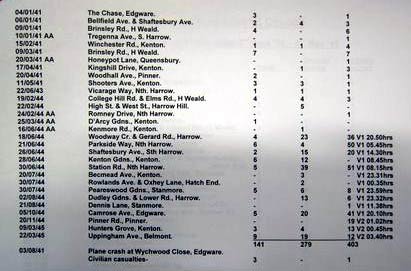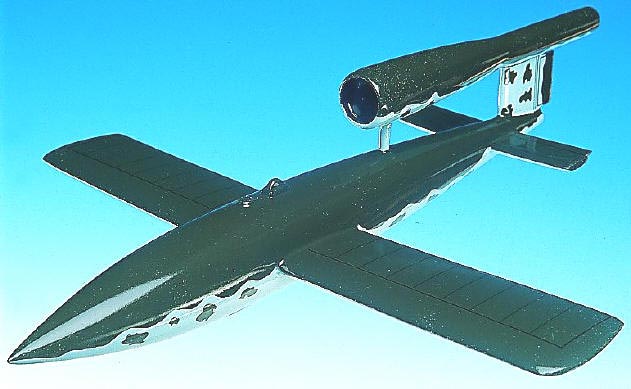
The Germans fired 9521 V-1 bombs at southern England. Of these 4621 were destroyed by anti-aircraft fire or by RAF fighter. The first V-1 on Britain landed on Southampton on 13 June 1944. it was a small, unmanned, guided aircraft that was loaded with 11830 pounds of explosive that went off on impact. The launching ramps along France's channel coast had already been installed in the summer of 1943. The V1 flying bomb was launched from an inclined catapult track. A piston hurled it into its trajectory using chemically produced steam pressure. Once it reached a velocity of 200mph, its pulse jet engine accelerated it to twice that speed, propelling it to London in 22 minutes.And at its peak, the Germans were launching 190 a day. An estimated 6184 people were killed by V1s.
From another source - The Fire by Jorg Friedrich - 8839 V1s targetted London, of which 27% struck residential areas, killing 5745 people
The V-1 was made from a welded steel fuselage and wings, and was launched from “ski jump” sites along the French and Dutch coasts, which catapulted the flying bombs into the air. Once airborne the pulse jet engine pulsed 50 times a second, emitting a characteristic buzzing sound giving rise to their colloquial name of “buzz bomb” or “doodlebug” (after an Australian insect).
A simple autopilot regulated the bombs height and speed. Then there was a small unpowered propeller in the nose which was attached to a counter. The counter determined the range of the bomb, and was preset before take off. Once the counter reached its preset, the motor was cut and the bomb fell to the ground. It was not an accurate weapon.
Initially anti-aircraft gunners found these small high speed targets difficult to hit. But eventually the guns obtained a predictor fire control system based on an analogue computer, which improved their accuracy. By August 1944 only 20% of those fired reached England.
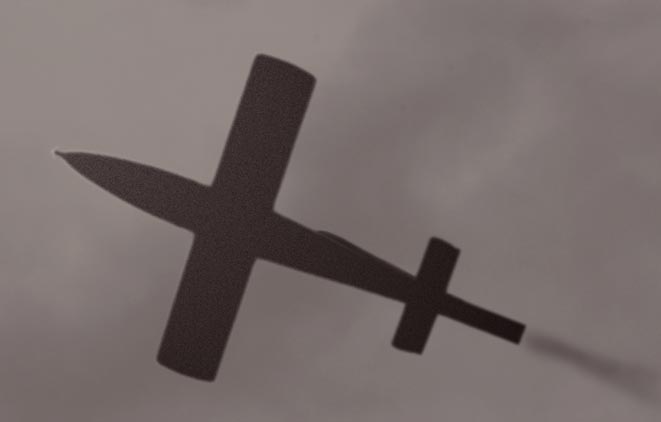
Of the 4621 flying bombs downed, some 1700 were shot down by fighter aircraft and a further 300 by barrage balloons.
When a V-1 hit the ground it caused blast damage over a wide area. A huge blast wave rippled out from the epicentre. This left a vacuum, which caused a second rush of air as the vacuum was filled. The combination caused a devastating push and pull effect. Houses were totally destroyed; brick walls were broken into small fragments. A little further from the epicentre, walls, roofs and window frames were ripped out, exposing the inside of the house. Further out windows were blown out and slates ripped off. The total blast area of a V-1 extended out in a radius of 400 to 600 yards from the epicentre.
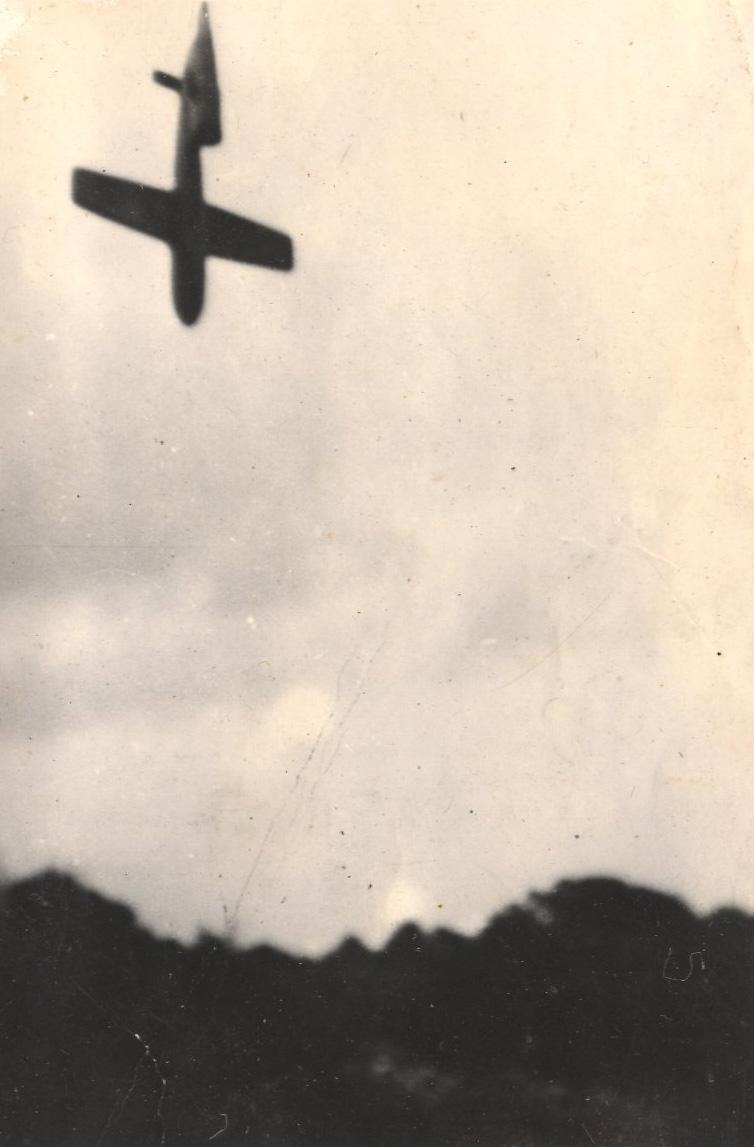
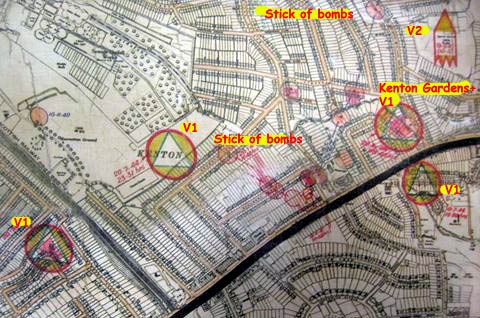
The bomb that hit Kenton Gardens killed 13 people, including one who was never identified. The investigators concluded that it was one of the infamous "glider" doodlbugs that hit Kenton Gardens. It is believed that the engine cut out over Kingsbury, about 4 miles away. Instead of diving as the earlier types did, this bomb glided in a low trajectory towards the back of this row of houses at Kenton Gardens. Its point of impact was four houses away from number 5 (I assume the witness believes it hit number 13) and it was calculated that it actually struck at the base of that house.
Two semi detached pairs plus half the next pair were demolished by this V1. This would appear to be 7, 9, 11, 13 plus 15. Without any warning there was a colossal compression and explosion immediately followed by all kinds of crashes, bangs screams, sounds of breaking glass and god knows what else.
 .
.
The above photo was alledgedly taken from Alicia Close, just to the north of Kenton Gardens. . It could still be of the "glider" variety that the above "investigators" refer to, the photo being taken once its engine had cut out after the glide . Sent to me Oct. 2010 by David Crellin. At the time my Grandparents were living in Alicia Close which is quite close to the site of the bomb landing. However I had heard nothing of it until very recently when I came across the enclosed rather remarkable picture which claims to be of the bomb falling. I think it has to be genuine as I can’t think how else it would have got into the family album. Grandfather Thomas Crellin was a professional photographer. He worked for Kodak and at the time we think he was working on reconnaissance photography.
 .
.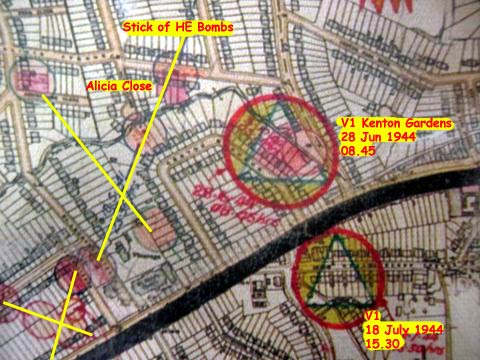
The originals of the above 2 copyright maps, - without annotations! -reproduced with permission of Harrow Local History Service - to whom many thanks. Email contact : Attn. Hazel localhistory.library@harrow.gov.uk. Alicia Close is marked as this was where the V1 picture above was taken
..
John Lyons visited the old V1& V2 rocket factory in Nordhausen,the Harz mountain underground munitions factory, in 2014 :
The Nordhausen site was opened to the public about 10 years ago. After the war it was left derelict by the East German authorities and the tunnel entrances blown up. It was the site of the infamous Dora Mittel concentration camp where 25,000 souls perished in construction and armaments production, The visitor centre provides a really good insight to how the V1 & V2’s were designed and produced. Once built, the missiles were transported right up through Germany by train to the Pas De Calais for firing. During the re-commissioning work they bored a new tunnel down to the original underground factory and opened up a 1 km section which you can see with a guide. Boy was it cold down there!! and really eerie –to see all the old machinery and components lying around after 70 years. At its peak, they were turning out 400 missiles a week.
After the war the Americans removed much of the components and technology and shipped it back to the USA. The area then became part of the GDR, the Soviets blew up the tunnel entrances and effectively sealed off the site. Following German reunification two of the entrances were later excavated and one is now open to the public for guided tours. The remains of production are clear to see and reminds us not just of the horrors that these weapons caused but also the suffering of thousands of prisoners who were forced to work underground in appalling conditions. In some tunnels the average survival time was just a month due to hazardous chemicals, a lack of fresh air and little nutrition. In all I recall that around 19,000 perished there.
In 2016 there was a BBC radio program on 11/7/2016: apparently about 6000 lives were lost in England due to these rockets. On 18/6/1944. on a Sunday. ~120 were killed when the Guards Chapel in Wellington Barracks suffered a direct hit. Churchill considered using poison gas on German cities as retaliation!